
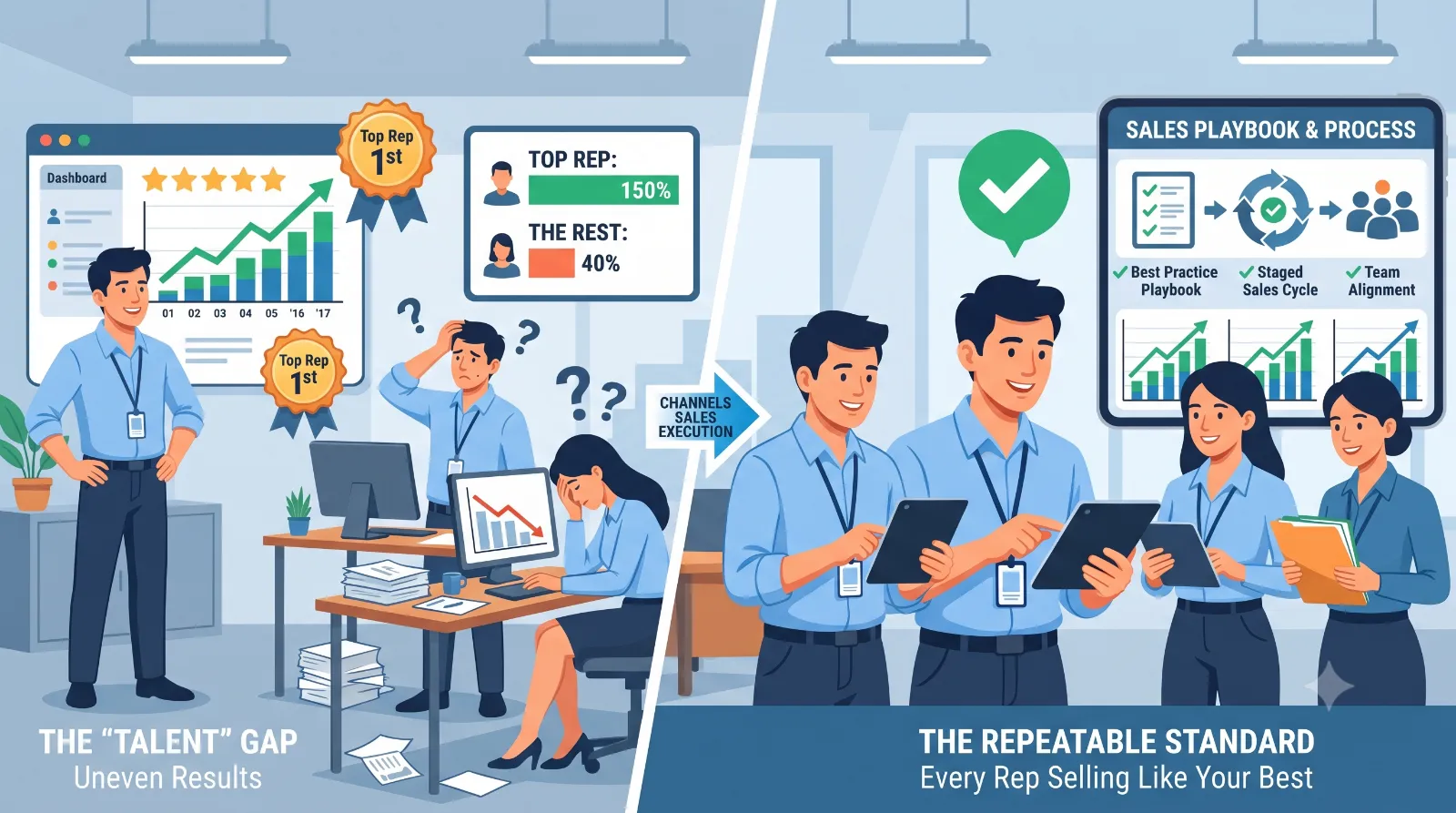
Every distributor knows the pattern. One rep walks into an account and knows what to say. They know which products fit, what was bought last time, which promotion applies, and what needs follow-up.
A newer rep walks into a similar account with less context. Price becomes the easiest answer when the customer pushes back.
The gap looks like a talent problem. Often, the deeper issue is process.
Your best rep has learned how to prepare, what to notice, what to recommend, and how to follow through. Other reps learn by trial and error.
The better question is simple. What if your best rep’s way of selling became a repeatable process for every rep?
The Best Rep Knows More Before the Visit Starts
Top reps have context. Before a visit, they often know the account’s buying pattern, customer preferences, previous discussions, applicable pricing, and open opportunities.
A newer rep often accesses the same catalog yet lacks the context needed for useful action.
A large catalog creates a practical problem. No rep will remember every product, application, substitute, price rule, and promotion.
When useful information is hard to find, the rep falls back on what feels safe. Often, a familiar product or lower price feels safer.
This Is a Process Gap, Not a Talent Gap
Look closely at what strong reps do. Their results often follow a sequence:
- Prepare for the account.
- Understand the customer.
- Recommend the right product.
- Apply the right pricing.
- Record what happened.
- Follow up.
One rep follows the process naturally. Another skips steps. A third keeps knowledge in a notebook. A fourth relies on memory.
The sales team then produces different results from similar accounts over time.
The spread does not automatically mean some people have more selling talent. Often, the business has never transferred the best rep’s process to everyone else.
This is where Channel Sales Execution enters the picture. The goal is to make good field execution repeatable, so more reps arrive prepared and make better decisions during each visit.
When Reps Sell From Memory
1. Customer knowledge gets lost
Your reps learn useful information every day. Customers share preferences, pricing conditions, and new requirements.
If those details stay inside one rep’s memory, the business gets little value later.
A strong rep might leave with years of customer knowledge. Others forget useful details before the next visit.
Capture customer knowledge during the sales process, so information stays with the account.
2. Product gaps lead to discounting
Price is an easy lever when a rep lacks confidence in the product conversation.
Suppose a customer needs a coating for an unusual application. The rep does not know the best fit. A discount becomes easier to discuss than product value.
Discounting then looks like a discipline problem, even when the deeper issue is a knowledge gap.
Give the rep product information, customer history, and pricing context, and the conversation has more substance.
3. Promotions get diluted
Distributor sales often involve multiple pricing layers from manufacturers, distributor groups, and individual accounts. Remembering every combination is risky.
The rep needs customer-specific pricing at the moment of sale. Otherwise, a promotion loses impact before reaching the customer.
4. Coaching starts over
Ride-alongs and end-of-day feedback still matter. The problem comes when nobody records what the manager asked the rep to change.
Without a clear thread, the next coaching session starts from zero.
Structured coaching changes the pattern. Managers record the gap, the action, and the next check-in.
Turn Your Best Rep’s Process Into a Team Standard
A practical approach has four parts:
1. Put the right context in the rep’s hands
Before and during each visit, give the rep relevant customer history, product information, pricing, promotions, and open opportunities.
A newer rep should arrive prepared without spending years building the same knowledge.
2. Capture what the rep learns
Every visit should add useful information to the account record.
What changed? What did the customer ask for? Which product worked? What follow-up is due?
The next rep or manager then sees the same information.
3. Make pricing and promotions precise
The rep should see the price and promotion for each customer and opportunity.
This reduces guesswork and protects margin.
4. Turn coaching into a process
Managers need a simple way to record what they observed, advised, and whether the rep improved.
Each visit then builds on the previous one instead of repeating old feedback.
Channel Sales Execution Brings These Pieces Together
Channel Sales Execution connects the information a rep needs with the actions a rep takes in the field.
For a downstream distributor or reseller, the value is practical. Your team works with many customers, products, and brands. The challenge is helping each rep make better decisions without expecting every person to memorize the entire business.
Think about a rep visiting a workshop with regular purchases. A strong rep remembers the buying pattern, spots a need, recommends the right product, checks the price, and records the next opportunity.
A less experienced rep needs the same support.
Sales execution brings product knowledge, customer history, pricing, promotions, follow-up, and coaching together at the point of the visit.
What Changes for the Distributor?
| Area | What Changes |
|---|---|
| Rep preparation | More relevant information before each visit |
| Product selling | Better product recommendations |
| Pricing | Fewer pricing errors and avoidable discounts |
| Customer knowledge | Account learning stays with the business |
| Coaching | Managers track gaps and follow-up |
| New rep productivity | Less time spent rebuilding account knowledge |
Reps will still have different styles. The important parts of the sales process should remain consistent.
iSteer’s Shell deployment reported an 18.24% increase in annual sales and a 2X increase in pre-planned visits.
The results link preparation and field execution with sales performance.
A repeatable process gives the gap between top reps and the rest of the team a practical way to narrow.
The Bigger Opportunity for Brands
A brand often knows what shipped to a distributor, yet has limited visibility into what sold onward, to whom, and at what rate. Downstream sales data then stays inside the distributor.
A distributor-first platform gives distributors a reason to participate because their own reps benefit first. Brands then gain a path toward better downstream visibility.
Start with rep effectiveness. Build participation through useful field execution. Then expand into secondary sales intelligence when the relationship supports the move.
Make Every Rep as Good as the Best Rep
Your best rep has already shown what good selling looks like.
The question is whether the knowledge stays with one person or becomes part of the sales channel.
When customer knowledge, products, pricing, promotions, and coaching come together, reps get better support before and during each visit. Newer reps get a clearer path to productive selling. The business keeps knowledge inside the organization.
This is the promise behind Channel Sales Execution.
How iSteer Helps
iSteer Sales Channel brings customer knowledge, product information, pricing, promotions, and coaching into one field sales process.
The focus is simple: help reps arrive prepared, sell with better context, and build customer knowledge for business use.
For distributors and resellers, this means a more repeatable sales process across the team. For brands, this creates a stronger channel with consistent selling.
Schedule a personalized demo with iSteer to see how our Sales Channel supports field execution, customer service, and higher sales productivity.
FAQs
1. Why do some sales reps perform better than others?
Often, top reps have stronger customer knowledge, product familiarity, pricing context, and a repeatable sales process. The gap is often a process gap rather than a talent gap.
2. How does Channel Sales Execution improve rep performance?
Channel Sales Execution gives reps the right customer, product, pricing, promotion, and follow-up information during field visits, helping them make better sales decisions.
3. How does better customer knowledge reduce discounting?
When reps understand the customer’s needs and have the right product information, they have more to discuss than price. This helps reduce unnecessary discounting.
4. How does structured coaching help sales teams improve?
Structured coaching lets managers record feedback, track follow-up, and measure progress. Each coaching session then builds on the previous one.
5. How does iSteer help distributors improve sales execution?
iSteer Sales Channel brings customer knowledge, product information, pricing, promotions, and coaching into one field sales process. Schedule a personalized demo to see how iSteer supports your sales team.
Related posts

What Your Best Rep Does That the Newest One Hasn’t Learned Yet
Discover repeatable best sales rep practices that improve sales rep performance and automotive sales performance. Capture tribal knowledge into a field playbook.
Read more
Why Even Good Reps Discount, and What Actually Stops It
Discounting often starts as a knowledge gap, not a discipline problem. Give reps the right product, customer, and pricing context at the moment of the sale, and price stops being the safest answer.
Read more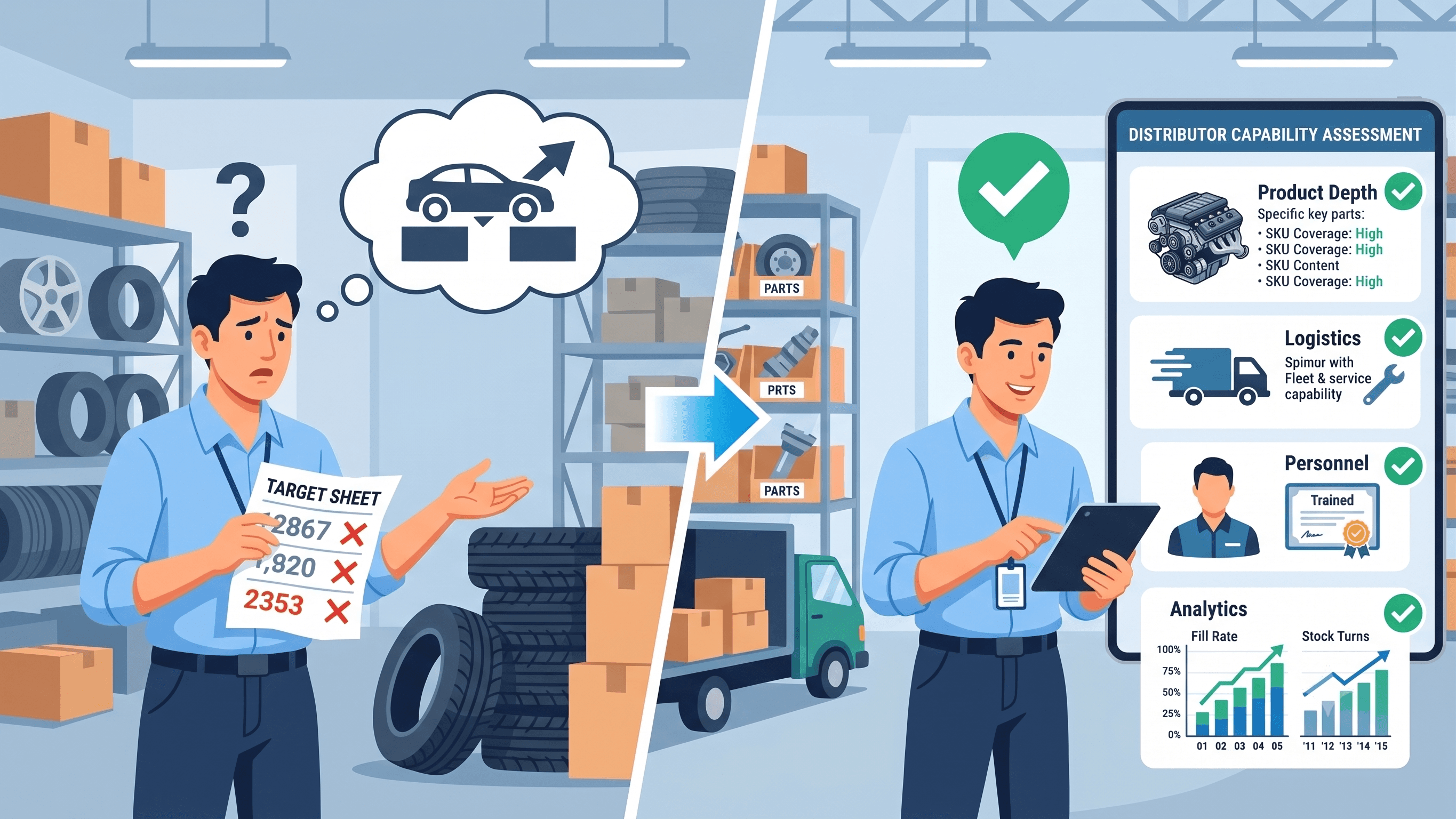
Why Automotive Aftermarket Leaders Are Rethinking Distributor Planning
Growth in the automotive aftermarket is constrained by distributor capability, not demand. Why leading manufacturers now start the planning cycle with a capability assessment instead of a target sheet.
Read moreSee how iSteer fits your sales and distribution channel.
Schedule a personalized demo with one of our product experts.